
From the lawyer suffering from AIDS and fighting a wrongful termination suit in the movie “Philadelphia,” the FedEx executive trapped alone on a desert island in “Cast Away” to the astronaut who was struggling to return to Earth after a moon mission goes awry in “Apollo 13,” Tom Hanks has excelled in diverse roles depicting seemingly ordinary men facing extreme crises.
Hanks, who holds the distinction of being the first actor in 50 years to be awarded back-to-back the Best Actor Academy Award (for “Philadelphia” in 1993 and the following year of “Forrest Gump”) builds his characters from the inside out, endowing ordinary people with a quiet but extraordinary bravery.
“Every movie is completely different and I wish they would relate one to the next but they don’t. It would be nice shorthand if they did, but you start all over from square one,” says Hanks who takes on another extraordinary character in his latest movie “Captain Phillips.”

A movie based on a true story, the 57 year old actor gives a performance of stunning humanity as veteran merchant mariner Richard Phillips, a sea captain who was held hostage by Somali pirates in 2009.
As the film begins in Vermont, we met a pensive Captain Phillips (Hanks) getting ready to leave his family to sail cargo halfway around the world. Several thousand miles away in a poor Somali Village, we are also introduced to a former coastal fisherman Muse (Barkhad Abdi) who is seeking cohorts to hijack one of the high-value ships that passes through his coast every day.
As he makes his selection from a group of several men desperate for the task, the stark divide of the characters economic peril is painfully clear as a complete picture of the world the pirates come from is shown. It’s then we learn the history of Somali piracy and the economic imperatives that drive it.
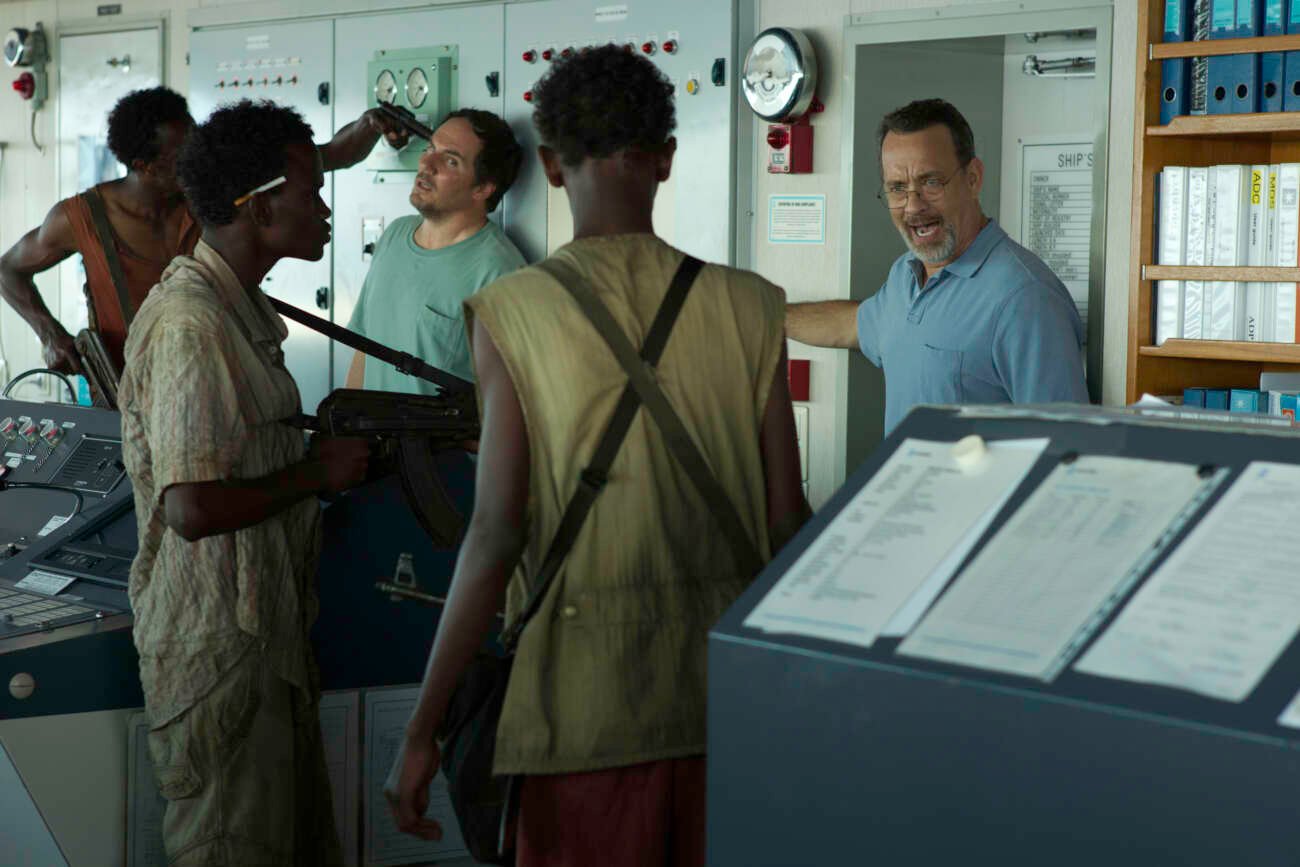
Fast forward a few scenes later and Phillips and his crew are on the Horn of Africa heading for Kenya with food and water supplies for the starving. Phillips knows he’s headed into pirate territory and keeps his crew on alert conducting drills. It’s during one of these drills they spot the pirates on their tail, and although they manage to avert a hijack he knows it’s just a matter of time before they return. Armed with machine guns and a determination to get rich the only way they know how, the pirates return the next day with a mission to board the ship. Once on board, the pirates are elated to discover that’s it’s an American ship but things quickly go haywire and they end up in a lifeboat with a miserly $30,000 and Phillips who they are planning to hold hostage for a bigger payday.

A portrayal which is certain to earn Hanks numerous awards “Captain Phillips” brilliantly balances the adventure of being at sea with the claustrophobia that comes along with being forced below deck for days.
“It was a very small space and very uncomfortable space,” shares the actor on filming the movie. “It smelled horrible, the air was bad and it’s hot and you are right on top of each other and we were in there for a very, very long time,” he continues. “But the director Paul set up an environment that was very realistic and I can’t imagine doing it any other way.”
Hanks, who stars alongside actors Barkhad Abdi, Barkhad Abdirahman, Faysal Ahmed, and Mahat M. Ali who play the Somali pirates met the actual Captain Richard Phillips who the story is based on to prepare for the role. Visiting with the captain at his home in Vermont, USA where he lives with his wife, Hanks found Phillips to be an affable, self-effacing man who never saw himself as anything more than a seaman simply doing his job.
“I found that he is a very pleasant guy and he is funny and you couldn’t ask for a better guy to hang out with.”
A realistic film that explores modern day piracy, what makes Hanks latest movie so engaging and intense is British director Paul Greengrass’ direction of a tight, terse screenplay which is adapted from the book “A Captain’s Duty: Somali Pirates, Navy SEALs, and Dangerous Days at Sea” written by the real Richard Phillips. Greengrass who directed “The Bourne Ultimatum,” and “The Bourne Supremacy” always opts for a sense of realism and minimalism in his movies.
The Somali pirates also live up to that ruthless title with their unpredictability and unwillingness to honor anyone else’s rules or timetables. Played by first time actors, Barkhad Abdi, Barkhad Abdirahman, Faysal Ahmed, and Mahat M. Ali, they all deliver solid performances in drawing the audience empathetically into their individual plights. Particularly brilliant is Barkhad Abdi as Muse, the pirate’s leader who refuses to give up even as the situation spirals out of control. His capacity for menace as well as compassion and contemplation is tremendous.
“For a young, first-time actor to inhabit such a complex role with such command was striking,” says Hanks. “He is a young Somali who harbors aspirations all of us can understand, but is utterly blocked from pursuing them because of incredibly arduous life circumstances in Somalia.”
Compelling, thrilling and thought-provoking “Captain Phillips” is one of the most involving and well directed films to be released this year and is highly recommended for anyone looking for intelligent thrills.
“They all achieved something and proved there is a small amount of people that can do this,” continues Hanks about his fellow actors. “The aspect of inhabiting a character and staying on story and on point while maintaining that character is something not everybody can do. These guys especially Barkhad were evident from the get go. Paul went to Minneapolis and found these four guys who are every much the creative artists. There is no substitute for true reacting and they all came in so primed and ready and lifted up everybody’s game mine included. ”
Hanks, a family man who is married to actress Rita Wilson and has two children and two grandchildren, got his big break in the ABC television comedy series “Bosom Buddies” in 1980.
Since then, he has starred in over seventy movies including “A League of Their Own,” “Sleepless in Seattle,” “The Green Mile,” “Road to Perdition,” “Catch Me If You Can,” “The Terminal,” “The Da Vinci Code” “Charlie Wilson’s War,” Larry Crowne (which he also co-wrote, produced, and directed), and “Extremely Loud and Incredibly Close.”
“Everything you have done in the past means absolutely nothing,” he shares. “You just have to trust your process, and the things that you have learned over the course of your career in taking on the next one.