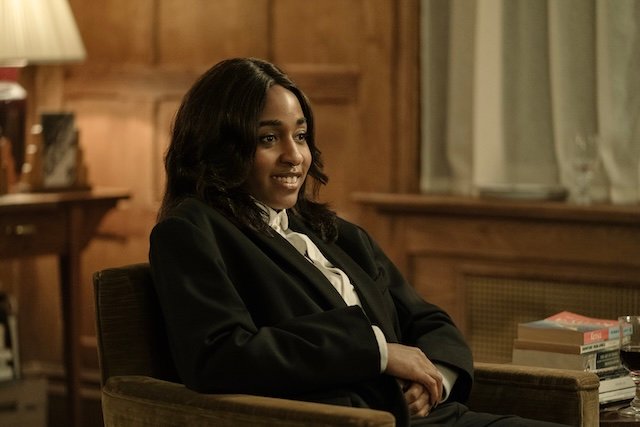
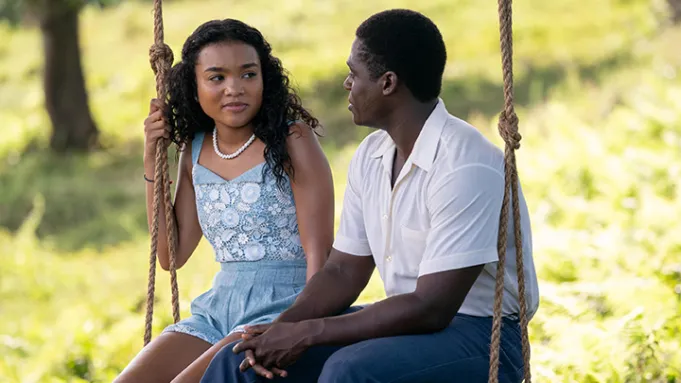

Littered with scenes that begin at a fever pitch before descending into a becalmed, meditative state, Hulu’s “Black Cake” is a beautifully constructed sentimental series. Simmering with strong relatable characters, steeped in culture, and rich with detail, much like the traditional Caribbean black cake where it draws its title, it follows two estranged siblings who learn about their late mother’s explosive and secret past. Based on The New York Times-bestselling novel by Charmaine Wilkerson, it’s an 8-episode series that opens with a frantic runaway bride racing to the ocean amidst the backdrop of a dynamic, sweeping score. It quickly switches to present day and we are introduced to Dr. Byron Bennett (Ashley Thomas), an ocean scientist sharing his nuance on the lack of diversity in his chosen profession during a career day event. He soon learns his mother, Eleanor Bennett (Chipo Chung), has cancer. After her death, Byron summons his estranged sister Benny (Adrienne Warren), and they discover several voice recordings Eleanor has left detailing confessions of her true identity and sharing devastating details of a childhood she had never spoken of. Charting her journey from the Caribbean to America, it’s a childhood that takes audiences back to Jamaica’s Portland Parish in the late ‘60s. As she narrates her life in a series of beautifully shaped flashback scenes, we meet the young Eleanor, then known as Covey (brilliantly played by Mia Isaac), who had a passion for competitive swimming and surfing. We are introduced to her best friend Bunny (Lashay Anderson), her first love Gibbs (Ahmed Elhaj) and Pearl (Faith Alabi), who raised her after her mother abandoned her when she was eleven years old. We learn of her own father’s trials and tribulations as a Chinese Immigrant disowned by his parents for marrying a Jamaican woman.
Scene after scene, Eleanor’s past unfolds through these seven taped confessions. She shares how her alcoholic father, Lin (Simon Wan) had courted her off to a local gangster called Clarence, to erase his gambling debts, but on the night of the wedding Clarence collapses and dies. Suspected of poisoning her husband, she sets sail, with Pearl’s help, to Great Britain. A fugitive on the run, she’s forced to take on menial jobs to survive and her new life in London is rife with racism, despair and discrimination. When she loses her roommate Eleanor Douglas (Karise Yansen), an orphan also from Jamaica, in a horrific train crash, she assumes
her identity desperate to forge a new life, but it’s a new life that comes with a hefty price. Despite her lack of credentials, she is hired at a Scottish trading company as a booker keeper’s assistant. It’s a pity hire by an unscrupulous owner who forcefully assaults her.

“You grow up thinking that when someone does something terrible to you, you will react. You will fight back.” She narrates after the rape.
She eventually returns to London and it’s at a Civil Rights rally where she sees her first love, Gilbert ‘Gibbs,’ Bennett, who had left Jamaica to study law in England. They rekindle their romance, marry and relocate to America where they start a new life cutting off all ties from their beloved Island roots.
The story develops slowly, introducing us to each character through actions and dialogue, allowing us to learn about their lives mostly in flashbacks. As Eleanor recounts her story, the narrative thrust keeps you engaged as the series drifts back and forth between past and present charting the consequence of hers, her mothers, and her father’s choices.
The score deftly drives the story along with vibrant images of Jamaica, where the scenes are lush with warm and sensuous colors.
From beginning to end, “Black Cake” is exceptionally well thought-out and unfolds with the fascination of eavesdropping as Byron and Benny unpack and disseminate the bombshells their mother drops with each recording. We also learn how their own lives were affected as they discover they have a mixed-race half-sister called Mabel (Sonita Henry) who resides in Italy.
“I am grateful that I still have time to right some of the wrongs in my life before it’s too late,” Eleanor cries out in that scene. In that explosive revelation, she confesses that she had a conceived a child during the rape in Scotland. A secret child she had also kept from their father.
“I can’t believe she didn’t tell dad about Scotland.” Benny says in the scene that follows. “The saddest part is that dad would have wanted to know,” Byron agrees.
Benny and Byron are forced to hold a mirror to their own imperfections and experience a rollercoaster of emotions while listening to the tapes. Estranged for eight years since a volatile Thanksgiving dinner when Benny was shunned by her father for her sexual preference, she still bears the mental scars of physical abuse by her former lover Steve. Byron, an instilled expert at bottling his emotions, is battling discrimination issues at work which have been
festering for years. There’s an added resentment towards his sister for failing to attend their father’s funeral.
“How could she have gone through so much and let dad be so judgmental with me?” a tearful Benny asks her brother. “You told me you would be at dad’s funeral. We waited for you, but you never came. Why?” Byron asks in return.
All of these questions linger. These are characters on divergent paths who finally settle down into deeper levels of interaction. It would be easy, but wrong, to describe the plot of “Black Cake” as mere familial friction. A relatable reflection of life with issues being raised like rape, racism, sexism, sexual orientation, suicide, adoption, colonization, discrimination, diversity and identity, the series will resonate with anyone who has ever hidden a secret or told a lie. Tender and devastating, this is a film about a family who have all been affected by a wrong choice and of a woman who wrestles with childhood trauma and sexual abuse. It’s somber, it’s sweet, it’s dramatic as it delicately weaves a tale of deceit tainted with decades of repressed resentments raising questions about the daily choices we make.
“If I had shared my secrets, it would have brought us closer.” Eleanor reflects in one scene.
The art and skill each actor brings to their respective role is almost flawless. From Wang’s energetic portrayal of Lin, the quiet and intense power Thomas displays as Byron, to young Covey who is played with fierce truthfulness by Isaac, there is quality in the performances. The series depends on Isaac, and she deserves its trust. Glynn Turman as Charles Mitch, a successful lawyer in Newport Beach, Calif. rounds off the main cast. His priority is to honor the final wishes of his client by ensuring the siblings listen to the tapes together. Well documented and chronicled, it’s also a love story and a stirring memoir with difficult themes and examines how a secret rippled through the years. Like the black cake with its sweet and tart ingredients which are left to saturate and simmer for months, Eleanor’s secret life has been kept hidden for years.
“I promised myself I would take all of this to my grave,” she recounts. “I didn’t want to burden you with the weight of it. Even when you bury the truth it still eats away at you.”
The staple black cake is a thread that runs through the series and it is baked for both of her weddings, a birthday celebration, her roommate’s graduation and every Thanksgiving. There is even a debate on which culture can claim ownership of cake’s origin since the recipe was modified in the Caribbean. But despite the tweaks of this rich recipe, the soul of black cake and what it embodies still remains. In Eleanor’s final tape, she informs them of a black cake that she has left in the freezer. In it she has placed another recording. “Sit down and share it when the time is right,” she instructs. Even in death she wanted her children united and black cake serves as that unifier.
Featuring guest directors that include Mario Van Peebles and Oprah Winfrey as a co-executive, “Black Cake” takes place in Jamaica, Italy, Scotland, England and Southern California and shines a light on black achievement. The characters are accomplished professionals. Byron has always wanted to be an ocean scientist since he was six years old and has achieved that dream. Benny is an accomplished artist, Mabel, the half-sister they eventually meet, is a renowned food critic and Bunny, we later learn, became a famous author. Despite its difficult themes, it doesn’t dwell on negative stereotypes, nor focus on the political conflict that plagued Jamaica during that era. Enriched with music which helps the story, Ska and Rocksteady somehow seems passionate, lilting and comforting, all at once.
This selection of memories, filtered through the eyes of a young woman is a series about love, tradition, sacrifice, unification and hope. There are lessons and takeaways – one being that we do have the power to change our own lives and fate doesn’t deal all of the cards and that sometimes somethings are best left unsaid. Inspirational and educational it is also entertaining, as shows must be before they can be anything els