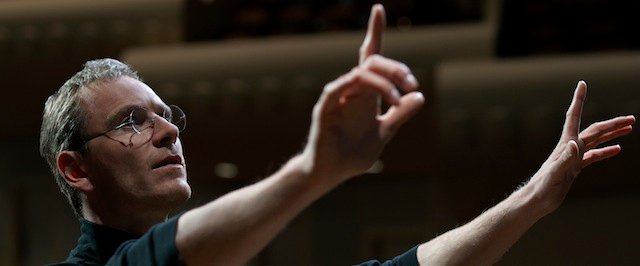

Dramatic and dialogue driven, the autobiography on Apple founder Steve Jobs has already grossed over two million dollars since its theatrical U.S. release. Starring Kate Winslet and Seth Rogen, the film, which is directed by Danny Boyle is being touted as a possible Oscar contender for best actingperformances.
Samantha Ofole-Prince caught up Michael Fassbender to talk about playing one of the world’s renowned inventors.
What is this film about Steve Jobs that makes this story such an important one?
This story is important because Steve Jobs changed all of our lives. He changed the way the world works, the way we communicate and interact with one another, how we watch films, how we listen to music and how we buy goods. Somebody who had that sort of influence deserves to be reflected on.
How did you initially approach the script?
Aaron Sorkin [screenwriter] writes to a certain cadence, so I spent a lot of hours by myself working with the script. Thankfully, Danny had the foresight to build in a rehearsal period between the filming of each act, which is very rare; that never happens. I will be eternally grateful, because I would never have been able to film at this pace without that.
Few can argue with Jobs’ accomplishments, yet many are swift to point out that not all of his methods were popular. How does he come across to you?
Steve Jobs was very aware of the need to constantly be moving forward. How many days off did the man take in 40 years? I would bet not many. If you have a vision you’re trying to realize, and you spend roughly 40 years driving that vision, that’s quite the feat. There was an element to Steve Jobs that enabled him to relentlessly drive this vision forward for decades. Sometimes people got trampled along the way. Would he have been able to achieve what he achieved without that force of will? I don’t know. But they seem to be interwoven—he was a complex human being.
What do you think director Danny Boyle brought to the set?
Danny is positive and encouraging and full of energy. The energy he brings to the camera is incredibly important for a piece like this—it’s essentially people talking quite a bit for close to two hours. Danny comes from a history of theatre; that’s really where he started his apprenticeship, so he understands that world. In a lot of respects, this script is a very theatrical story. A lot of the time, it seems like characters are entering from the wings; you could very easily see this being staged as a play.
It was considered general knowledge inside Apple that only one person could spar with Jobs at his level and sometimes win was his head of marketing Joanna Hoffman. What did Kate Winslet bring to her interpretation of the character of Joanna?
I think Joanna had quite an impact on Steve. She keeps him honest, and I think Kate really captures that spirit in her performance. Her ability as an actor is second to none. When it came to filming with her, we had a lot of fun. She’s very intuitive, and also very technically brilliant.
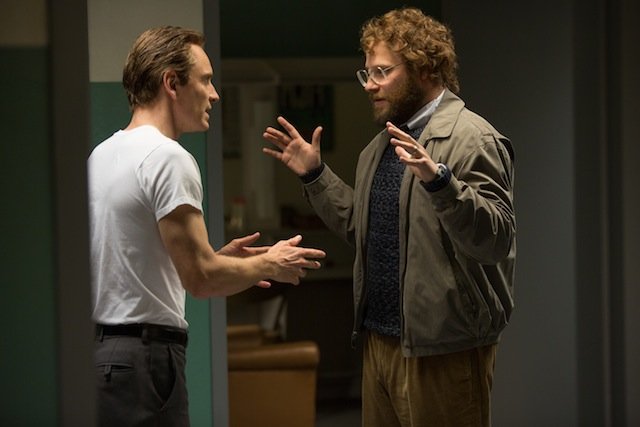
The relationship between Steve Jobs and Steve Wozniak—played by Seth Rogen—is treated with great nuance in the film. It was obviously very complicated. How do you see the relationship? And how was working with Seth?
I think Steve really knew that he had met somebody special in Steve Wozniak. He knew that Woz was going to be the vehicle for him to get into the business. I think it’s the classic pair, and I think that’s why they worked well together. One was the designer-genius in terms of building the Apple II, but he needed a visionary like Steve to take it where it went. Seth is extraordinary and professional. He is so generous, relaxed and easy-going, but also one of the hardest working people I’ve ever collaborated with and brings such humanity and a real honesty to his characters. With Wozniak, he incorporated these tiny mannerisms and folded in these little shadow moves beautifully—like the way he holds his hands—but it never became clunky or self-conscious.
When Steve Jobs died, there was a vast outpouring of grief on a global scale. What was it about Jobs that touched people so much?
Anywhere you go now, people are walking down the street looking at their iPhone—they’re recording, photographing, texting, emailing, tweeting. He was definitely a visionary on many levels, not just with regard to the personal computer and what he did has changed the way we live our lives. It’s that simple and yet, that far-reaching.
Photo Credit: François Duhamel/Universal)